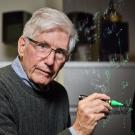
Currently finishing up a fellowship at the Carnegie Theoretical Astrophysics Center in Pasadena, Calif., Mockler will join the UC Davis campus in summer 2026. The move is a homecoming.
Mockler was raised in Davis, and it was while she was attending Ralph Waldo Emerson Junior High that her fascination with space was ignited.
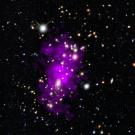
Prof. Wittman's research group's work on a merging galaxy cluster was highlighted by a NASA press release. The group was working on identifying clusters that are undergoing major mergers when, a few years ago on December 31, they found this excellent candidate and Wittman told his collaborator "You can have some Champagne tonight!" The nickname stuck as the group obtained follow-up observations with the Keck Observatory and the Hubble Space Telescope.
Nature just came out with their list of 10 people who "helped shape science in 2025." One of the ten is our own Distinguished Professor Anthony J. Tyson described as "the visionary behind the brand-new Vera Rubins Observatory." We're glad they see him as we do!
Researchers in the UC Davis Department of Physics and Astronomy have developed a simple way to tell, quickly and quantitatively, whether a theoretically predicted material is actually present in high-throughput powder X-ray diffraction (PXRD) data, or if it likely never formed at all.
David J. Webb (UC Davis Dept. of Physics and Astronomy) and UC Davis alumna Cassandra A. Paul (San Jose State University Dept. of Physics and Astronomy and Science Ed. Program) have new results in physics education research.
Using a global network of telescopes, astronomers have detected the lowest-mass dark object yet found in the universe. Finding more such objects and understanding their nature could rule out some theories about the nature of dark matter, the mystery substance that makes up about a quarter of the universe. The work is described in two papers published Oct. 9 in Nature Astronomy and Monthly Notices of the Royal Astronomical Society.
The Compact Muon Solenoid (CMS) Collaboration, which has a large number of members at UC Davis, was awarded the 2025 Breakthrough Prize in Fundamental Physics.
From August 9th to 15th, UC Davis was the local host to the North American Particle Accelerator Conference (NAPAC-25) at the SAFE Credit Union Convention Center in Sacramento, along with SLAC NationalLaboratory, Lawrence Berkeley National Laboratory, and Lawrence Livermore National Laboratory. Professor Eric Prebys (pictured at the left) served as the Chair of the Local Organizing Committee. This conference welcomed over 400 attendees from around the country and the world.